
In the age of the internet, where information is available in abundance, search engines want to provide the best content to the users. According to recent surveys 61 % of netizens are using internet to shop online and 44% of them use using it for searching products.
However, the research also shows that most of the users only scan the first page of Search engines.
All the SEO experts are well aware of this fact, hence they continuously keep on updating their SEO techniques to stay on top.
If you are an expert or even a fresher looking for the latest, best on-page SEO best practices to achieve better results, traffic or conversions, then your search ends here. You will come across the best on-page SEO practices in 2025, in a very simplified manner, so that even a beginner can implement them.
1. Optimising content
The quality of the content is one of the most important decisive factors. People visits your page to find an anwer to your question or buy a product. So, your content should be well structured, updated, engaging and attractive. Adding on, it should be search engine-friendly or searchable at the same time. Let’s find out how we can do that?
1.1 Keywords analysis
Keywords are the phrases or words that users type to search for something. Right usage of these keywords brings visitors to your sites.
Keyword analysis is used to find keywords relevant to the website, and at the same time, words that are most searched on search engines. It is advisable to target specific keywords to rank higher. The usage of long or medium-tail keywords makes your site more searchable.
Google Adwords is a highly recommended tool to conduct keyword analysis.
1.2 SEO copywriting
Google has mentioned many times that the content should be created keeping users in mind. You can optimise it for search engines later. This is known as SEO copywriting.
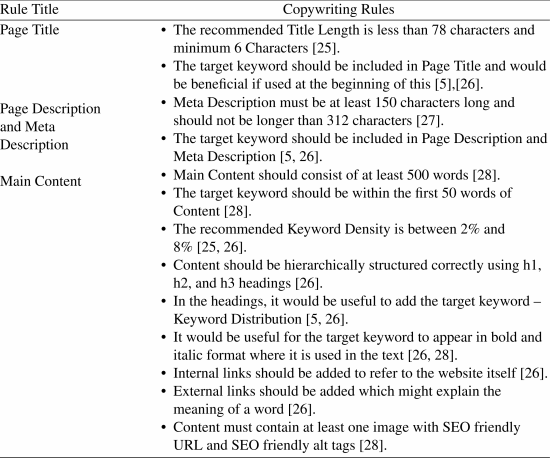
Refer to this image to make a perfect piece of content that is both user and search engine friendly.
1.3 Title and heading tags
- Your page title should have an H1 tag. •
- Subsequent headings on the page should have an H2 or H3 tag, and so on.
- Use your primary keyword in your page title.
- Keep your title under 60 characters, if possible. •
- Make sure both your page heading and title answer the searcher’s primary question. •
2. SEO friendly URLs
URLs are like the postal address to your website. Search engines consider URLs while indexing your site. Search engines assume that the target keyword is in the URL itself.
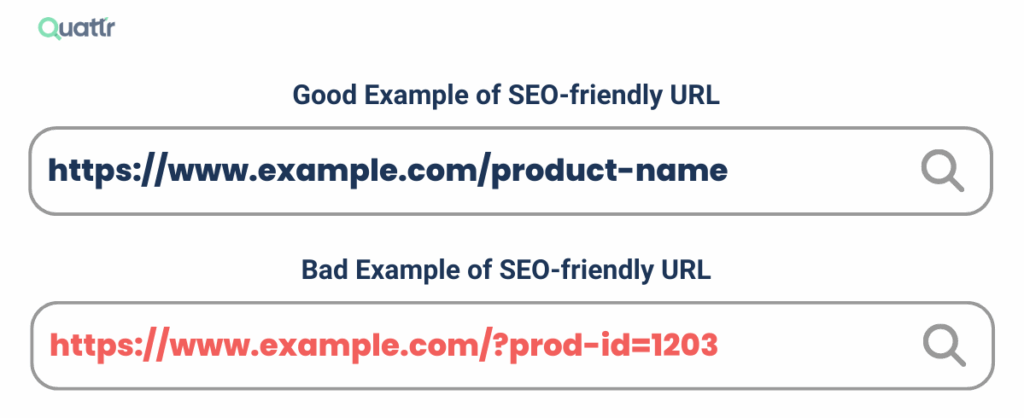
- The URL rewrite module can be used to achieve a SEO friendly URL.
- Many open source CMS platforms, such as WordPress, also provide such URLs.
- To obtain a SEO friendly URL, a developer has to use a combination of scripting language with web server software.
- Use hyphens between words in your URL
- Keep your URLs short and simple.
- Make sure your URL describes the page that users will be landing on.
- Include the target keyword in your URL
3. Meta descriptions & Meta keywords

Meta descriptions is a summary of your webpage which is displayed beneath the bluelink on search engines. Though it is not the official ranking factor, it indirectly impacts SEO.
An attractive meta description drives traffic, increases click-through rate, informs the right people at the right time and pulls social media.
- Be informative and add value.
- Include specific target keywords.
- Aim for 155-160 characters.
4. Optimising Images
Images no longer just add representative value to your site. They play an important role in reaching your site. By adding image alt text, you tell Google or other search engines what the images are all about.
Moreover, image size decides the load time of a site. Many a time, users exit from a site due to its excessive loading time. Ideally, the image that has a perfect balance of quality as well as image size is less than 100KB.
Tools like Adobe Photoshop or Squoosh are used to resize images before uploading them to the site.
5. Sitemap, robot.txt, RSS
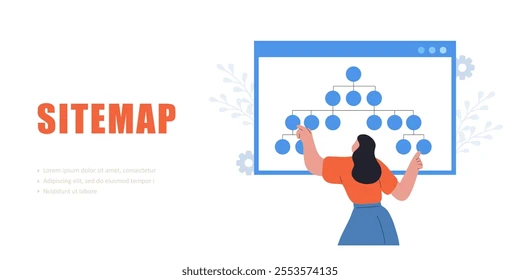
Create a sitemap for your website. A sitemap is an XML file of your website files that explains to search engines the content on your website. Otherwise, search engines run algorithms which can give a wrong comprehension.
A robot txt. A file is a text file created by webmasters to instruct web bots how to crawl the site. This differentiates your site from others, by improving crawbility and indexing.
RSS is also a decisive factor while ranking the website.RSS tells the users about the new pages on the website.
6. Responsive Design
Today, half of the internet users come from either smartphones or tablets. So, it is extremely vital to build a mobile-friendly website. If users are unable to navigate your site on phones, they will soon.
Bounce rate and conversion rates are considered as ranking factors. So, your site needs to mobile mobile-friendly to sustain users.
Google has launched a tool named Mobile-Friendly Test you can use to access your site. If your site is not responsive, then choose a web server, layouts, templates, etc. that are navigable on a phone.
7. Internal Linking
Linking between two pages is used to build authority. It is based on the Google algorithm, PageRank.
- Add a section of “related posts” in your content.
- Use the Yoast SEO plugin in WordPress to create better links.
- Make sure your internal links are “follow” links.
- Provide relevant links that add value or information for users and help search engines navigate
Internal linking forms a web within your website. It enhances the user experience, keeping them engaged within the site.
8. Technical SEO
Now, it is time to work on some technical aspects of your website that will eventually help Google crawl and index it better. If you are a beginner, you will need some assistance from a developer to implement these practices.
8.1 Robot.txt.
- Basic formats of robots.txt. Files are-• User-agent: [user-agent name] & Disallow: [URL string not to be crawled]
- Do not put information like sensitive profiles, images, client data, etc. in these files.
- You can hire a developer to create it or most use one provided by CMS.
8.2 Canonical tag
- It is used to differentiate the important pages that you need to crawler to focus on, in case of identical or duplicate pages.
- Use the canonical tag on the page you want to drive traffic to.
- Conalise the website’s homepage.
- Regularly audit your tags
8.3 SSL Certificate
Get an SSL certificate from the CMS providers. Search engines prefer secure websites. An SSL certificate ensures that your site is served securely over HTTPS.
8.4 Redirect Codes
- 301-Use this code to permanently redirect to another URL. It passes the ranking power and link equity to another page.
- 302-This is used when the site is under construction.
- Create appealing redirect pages to improve user experience.
8.5 Site Speed
- Site speed is a crucial ranking factor; it directly impacts bounce rate and user experience.
- Compress images to increase site speed.
- Use Google PageSpeed Insights to test the speed of your site.
You have walked through all the significant on-page SEO practices practised in 2025.
Why are the best on-page SEO practices Important?
- On-page SEO practices make your site optimal for both humans as well as search engines.
- It informs search engines about the valuable content you offer to users.
- The site becomes more searchable and user-friendly.
- A well-optimised site gains a competitive advantage.
- Best SEO practices boost search engine visibility, click-through rate and conversion rates.
Wrapping Up
With the dawn of the click era, searching styles are evolving. Only the first page results get the privilege to be viewed and shared.
In such a competitive scenario, SEO experts, digital marketers and entrepreneurs need to stay updated with trending SEO practices to stay on top.
Making subtle changes to a website leads to significant results, as discussed above. Relevant, fresh, valuable and optimised content is the key to magnetise desired traffic. Other factors like loading speed, internal linking, reviews, plus user friendliness also play a major role in deciding the rank of your site.
With the aid of the on-page SEO best practices, the websites become more crawlable and get indexed, ranked priorly.
We are always happy to help!
Digiintern is amongst the finest digital marketing agencies, which aids businesses in nurturing their business online. The team is always happy to address queries related to on-page SEO. Under the guidance of experts, you will get multifold results from SEO practices.
FAQs
| Q1 How long does it take to get results from SEO? A1 It usually takes 2-3 months to get visible results from the right SEO practices. |
| Q2 What are the main on-page SEO factors that impacts on ranking? A2 The main on-page SEO factors are-ContentWebsite securityLinksSite speedResponsiveness |
| Q3 What are two types of traffic, and which one is paid? A3 There are mainly two sorts of traffic, paid and organic. Paid traffic is traffic you get when you pay for search results. Organic traffic is the traffic generated by SEO. |
Related Posts
1. Understanding and implementing of Off-page SEO techniques
2. Reverse-Engineering Google’s Algorithm – All SEO Secrets You Need
